ASMR stands for Autonomous Sensory Meridian Response. On social platforms, ASMR describes content designed to create a pleasant tingling sensation, typically starting on the scalp before spreading through the neck and spine.
Creators tag this content #asmr on TikTok, YouTube, and Instagram so viewers searching for relaxation or sleep aids can find it easily.
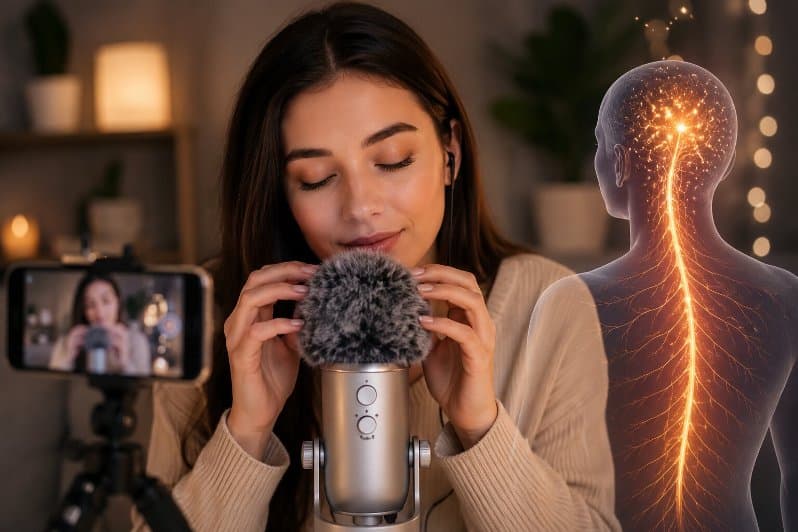
The name itself is descriptive if you break it down. “Autonomous” means the response happens on its own, without conscious effort. “Sensory” refers to the physical feeling involved. “Meridian” points to a peak or high point in that feeling. “Response” is simply the reaction itself. Put together, it describes a body reaction people get from certain sounds or visuals, not a genre of content.
Where the Term ASMR Came From
The term ASMR was created in 2010, not by a scientist, but by a woman named Jennifer Allen who started a Facebook group called ASMR Research and Support.
People had been describing the tingling feeling online since at least 2007, usually calling it things like “brain tingles” or “brain orgasms,” but there was no agreed upon name for it.
Allen wanted a clinical sounding term that would not sound sexual, since many early forum posts were dismissed or mocked for that reason. Autonomous Sensory Meridian Response caught on because it gave the experience a label people could search for and rally around.
Within a few years, YouTube creators built entire channels around it, and the term moved from a niche forum phrase to a mainstream content category.
Read This: How IYKYK is Used on Social Media
How ASMR Triggers Work on TikTok and YouTube
ASMR content works by pairing specific sounds or movements, called triggers, with close up, slow paced filming. Common examples include:
- Whispering or soft spoken talking directly into a microphone.
- Tapping on objects like glass, wood, or acrylic nails.
- Crinkling or scratching sounds from packaging or paper.
- Eating and mukbang style videos with exaggerated chewing sounds.
- Roleplay videos, such as a pretend haircut, ear cleaning, or spa treatment.
- Slow, repetitive hand movements, sometimes without any sound at all.
Not every viewer reacts to the same trigger. One person might feel nothing from tapping sounds but get strong tingles from whispering, while another feels the opposite.
This is why ASMR channels post such a wide range of content types rather than sticking to one format.
Common ASMR Content Categories You See on Social Media
Most ASMR content on TikTok and YouTube falls into a handful of recognizable formats. Knowing these helps explain why the hashtag covers such different looking videos.
| Category | What It Looks Like | Typical Platform |
|---|---|---|
| Trigger sound videos | Tapping, scratching, crinkling with no talking | YouTube, TikTok |
| Whisper or soft speaking | Close mic narration at low volume | YouTube |
| Eating and mukbang | Amplified chewing and swallowing sounds | TikTok, YouTube |
| Roleplay | Pretend personal care scenarios like haircuts or checkups | YouTube |
| Oddly satisfying crossover | Slow, clean visuals like soap cutting or slime | TikTok, Instagram Reels |
The oddly satisfying category overlaps with ASMR often enough that people confuse the two. The difference comes down to sound design.
True ASMR content is built around audio triggers meant to produce a physical tingling response, while oddly satisfying content is built around visual smoothness and does not always aim for that same reaction.
Does ASMR Actually Do Anything? What Research Says
Yes, for people who experience it, ASMR produces measurable physical changes, not just a subjective sense of calm.
A 2018 study led by psychologist Giulia Poerio found that participants who watched ASMR videos while feeling the tingling response showed reduced heart rate and increased skin conductance, both signs of a genuine physiological response.
A separate 2023 brain imaging study found activity in emotion and empathy related brain regions during the tingling moments.
Not everyone experiences ASMR, and researchers still do not fully understand why some people respond strongly to certain sounds while others feel nothing. Some people even find common ASMR triggers, like chewing sounds, irritating rather than relaxing, which overlaps with a separate condition called misophonia.
Frequently Asked Questions About ASMR
Why do people watch ASMR videos on TikTok and YouTube?
Most viewers watch ASMR content to relax, fall asleep, or reduce stress. The videos use sound and visual triggers meant to produce a calming tingling response.
Does ASMR work for everyone?
No. Some people never experience the tingling sensation regardless of the trigger, while others find common ASMR sounds annoying rather than relaxing.
What is the difference between ASMR and oddly satisfying content?
ASMR is built around audio triggers meant to cause a physical tingling response. Oddly satisfying content focuses on smooth, clean visuals and does not always aim for that same physical reaction.
Is ASMR the same as white noise?
No. White noise is steady background sound used to mask other noise for sleep. ASMR relies on specific, identifiable sounds like tapping or whispering meant to provoke a response.
Can ASMR help with anxiety or sleep problems?
Some research links ASMR to reduced heart rate and improved mood in people who experience the tingling response, which is why many use it as a sleep aid, though it is not a clinical treatment.
Why do so many ASMR videos involve eating sounds?
Eating and mukbang style ASMR videos amplify chewing and swallowing sounds, which are strong triggers for many viewers, similar to tapping or crinkling sounds.
Conclusion
ASMR is not just a social media trend. It is a documented sensory response with a specific name, a known origin, and growing research behind it.
Once you know what the acronym stands for, it becomes clearer why ASMR videos differ from one creator to another and why the experience is unique for each viewer.