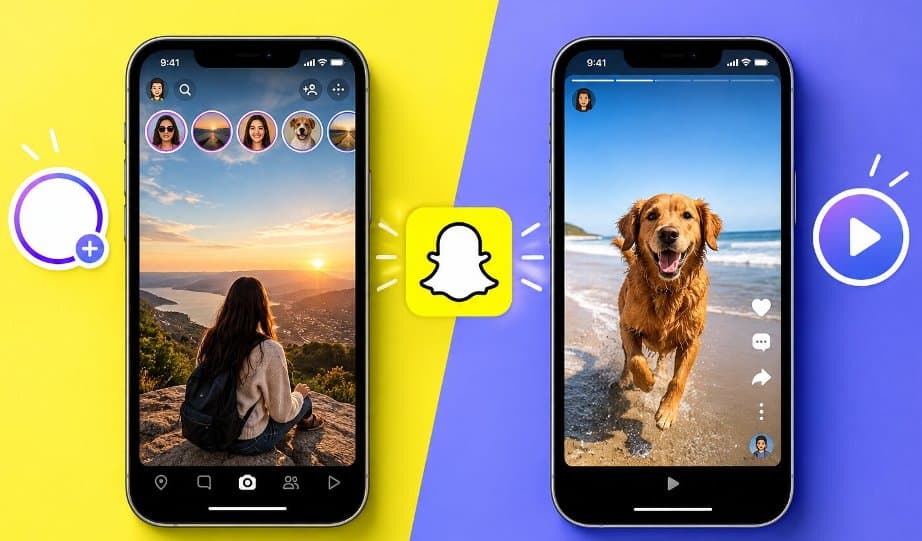
Snapchat splits its content into two separate feeds that look alike but do different jobs. A Story is a set of vertical clips your friends and followers see for 24 hours, ranked by how well you already know each other.
Spotlight is a discovery feed of short videos shown to strangers based on what the algorithm thinks they will watch, similar to TikTok’s For You page.
Snap’s own Q1 2026 earnings report shows how far Spotlight has grown: global daily active users reached 483 million, and Spotlight posters in the US climbed nearly 74% year over year while shares and reposts of Spotlight content jumped 62% year over year worldwide.
What is a Snapchat Story
A Snapchat Story is a collection of photos and videos that plays in sequence and disappears after 24 hours.
Only your friends, or the audience you choose in your privacy settings, can see it. Stories function like a running diary of your day, and they sit at the top of the chat screen where friends already expect to find them.
Snap ranks Stories using relationship signals. The app looks at whether the viewer finishes watching the sequence, how quickly they reply, and whether they come back to view again.
A Story from a close friend tends to appear before one from an acquaintance, regardless of when either was posted.
Stories are not built for reaching new people. They work best for keeping an existing audience engaged, answering questions from your community, and giving followers a reason to check in daily.
What is Snapchat Spotlight
Spotlight is Snapchat’s public short video feed, opened with the diamond icon at the bottom of the app.
It shows vertical clips from creators a viewer does not follow, chosen entirely by the recommendation engine rather than by relationships.
There is no algorithm choosing what a viewer’s friends posted; instead, Spotlight surfaces whatever content the system predicts will hold that specific viewer’s attention.
Spotlight ranks content on early retention. The first few seconds decide whether a clip gets pushed to more viewers, and rewatches count heavily toward that push.
A Spotlight video can reach millions of strangers even if the poster has zero followers, which is the opposite of how Stories work.
Who Can See Each Format
A Story is visible only to the audience you set: friends, a custom list, or the public if you choose that option.
Spotlight is public by default and can be watched by any Snapchat user regardless of whether they follow the poster.
This is the single biggest structural difference between the two formats. Posting to Spotlight means opting into a stranger audience; posting a private Story keeps the content inside your existing circle.
How Long Each Format Lasts
Stories disappear 24 hours after posting unless you manually save a clip as a Highlight on your profile, where it can stay indefinitely.
Spotlight content does not expire on a timer. Once posted, a Spotlight video stays live and can keep circulating through the recommendation engine for as long as it keeps earning watch time, sometimes resurfacing weeks after it was first posted.
Check Also: Snapchat You May Know vs Mutual Friends
How the Ranking Signals Differ
| Signal | Stories | Spotlight |
|---|---|---|
| Primary ranking input | Relationship and reply behavior | First seconds retention |
| Audience | Friends and chosen followers | Public, algorithm selected |
| Best for | Trust building, daily updates | Reach, discovery, new followers |
| Lifespan | 24 hours, or saved as a Highlight | Indefinite, can resurface later |
| Typical content style | Casual, sequential, conversational | Punchy opener, single strong idea |
Which Format Should You Use for Growth
The direct answer is both, not one or the other. Snap’s own data shows that creators who post to both feeds outperform single format posters, because each format solves a different problem.
Spotlight brings in people who have never seen your account before. Stories convert that new attention into a returning audience by giving people a reason to check back daily.
A practical split that many creators follow: treat Spotlight clips as standalone strikes with a strong opening shot and a clear payoff, and treat Stories as a multi card sequence that answers questions, shows behind the scenes moments, and responds to what viewers said in chat.
Shooting a dedicated opening shot for Spotlight, rather than recycling a clip cut from a Story, tends to raise watch time because Stories are paced for people who already know you.
Do Stories and Spotlight Use the Same Video Size
Yes. Both formats use a 1080 by 1920 pixel vertical canvas at a 9:16 aspect ratio, the same dimensions Snapchat uses for most of its ad formats.
This means a single shoot can produce footage for both feeds, though the framing and pacing you use for each should differ since the audiences are not the same.
Frequently Asked Questions
Can a Spotlight video be seen by people who do not follow you?
Yes. Spotlight is designed for discovery, so the recommendation engine can show your clip to anyone on Snapchat, not just your existing followers.
Does posting to Spotlight hurt my Story views?
No. The two feeds are ranked separately, so posting to Spotlight does not reduce how often your Story appears to friends.
What is a Highlight and how does it relate to Stories?
A Highlight is a Story clip you manually pin to your public profile so it survives past the usual 24 hour window. It is not a separate posting flow; you record a normal Story first, then promote it to a Highlight from your profile settings.
Which format is better for a brand new account with no followers?
Spotlight, since it does not depend on an existing follower base to get views. Stories only reach people who already follow you, so a new account needs Spotlight to get discovered first.
What ranks higher in Spotlight, a longer video or a short one?
Spotlight prioritizes what happens in the first few seconds and how often people rewatch a clip, not overall length. A short video with a strong opener can outperform a longer one with a slow start.
Conclusion
Pick the format based on the job, not the habit. If the goal is to reach someone who has never heard of you, post to Spotlight.
If the goal is to deepen a relationship with someone who already follows you, post a Story. Running both from the same shoot, with a distinct opener for each, is the setup most creators end up settling on once they see how differently the two feeds behave.